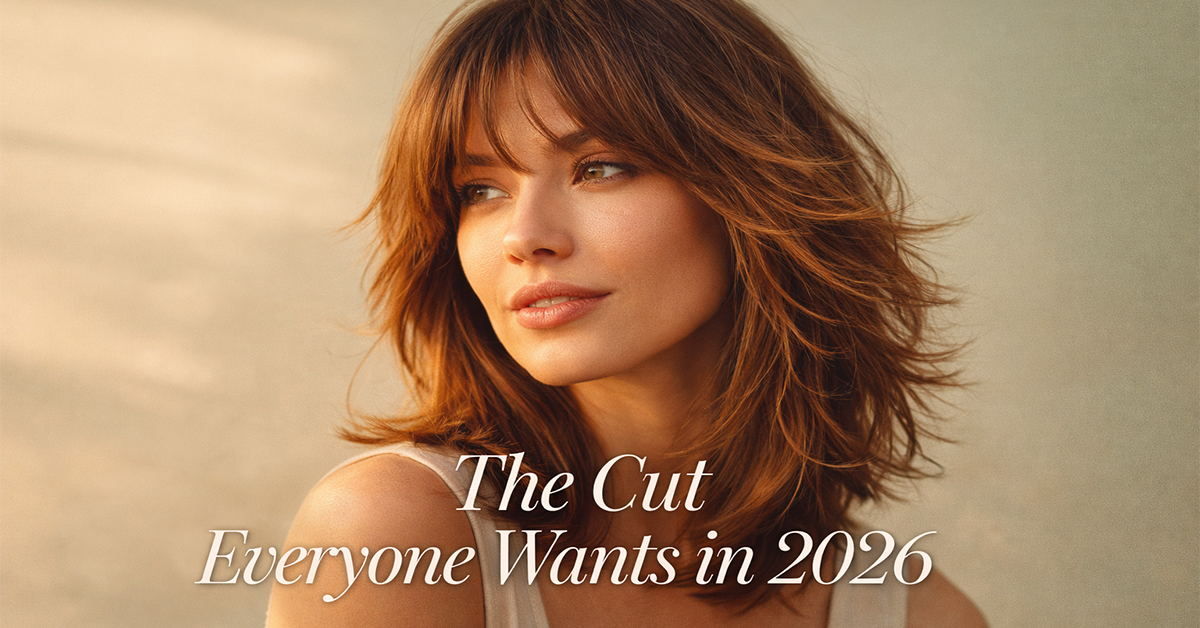
The blunt bob had a good run. But 2026 belongs to something softer, lighter, and honestly? A lot more wearable.
I’ve been noticing something lately. Whether I’m scrolling through Instagram, walking past a busy salon, or just paying attention to the women around me who always seem to have their hair figured out — there’s a specific look showing up everywhere right now. It’s not quite a bob. It’s not long, flowing hair either. It’s somewhere in between, with this incredibly light, airy quality to it that makes it look effortlessly good whether it’s just been blown out or hasn’t been touched since yesterday morning.
That’s the feather cut. And if you haven’t heard of it yet, you will soon — because in 2026, this is the haircut.
So What Exactly Is the Mid-Length Feather Cut?
Let me paint the picture clearly, because “feather cut” means different things to different people, and the 2026 version is specific.
We’re talking about hair that sits somewhere between the shoulders and the collarbone — that sweet mid-length zone that works for almost everyone. The length itself isn’t the whole story, though. What makes this cut distinct is how the layers are done.
Instead of heavy, chunky layers that sit on top of each other, the feather cut uses ultra-fine, delicately sliced layers throughout the hair. The ends are slightly fringed — just enough to give each layer that soft, feathered finish that moves when you walk and catches light in a way that makes your hair look genuinely alive.
At the front, almost universally, this cut is paired with curtain bangs. Not a straight-across blunt fringe — curtain bangs part in the middle or slightly off-center and sweep downward to skim the cheekbones and jaw. They frame the face the way a good pair of curtains frames a window: softly, and with intention.
The overall silhouette is relaxed but polished. Soft but structured. It looks expensive without demanding a lot of time — which might be exactly why it’s exploding right now.
Why Is This Cut Having Such a Massive Moment in 2026?
Here’s what I think is actually going on. For the last few years, there’s been a cultural push toward extremes in hair — either very short and bold (the micro-bob, the buzz cut, the shag), or very long. The in-between length got dismissed as a “growing-out phase” rather than a destination.
That’s changing. People are tired of high-maintenance cuts that demand weekly styling and monthly trims just to stay looking intentional. Extremely long hair, as romantic as it sounds, requires real time and effort. And dramatic short cuts are a commitment that not everyone wants to make.
The feather cut hits a genuinely practical sweet spot. You can tie it back for the gym. You can throw it in a loose bun for work. You can wear it down in the evening and look like you tried. The cut does the heavy lifting — the layers give it shape and movement even when you haven’t touched it with a tool since the morning.
There’s also something in the aesthetic mood right now. The whole “quiet luxury” and “effortless chic” direction that’s been building in fashion has finally fully reached hair. Soft, natural, unfussy — but clearly considered. The feather cut is exactly that energy in haircut form.
Who Does the Feather Cut Actually Work For?
Honestly? Most people. That’s part of why stylists are so enthusiastic about it.
If you have thick hair, the soft layers take out weight and bulk without thinning your ends to transparency. Your hair will finally move instead of sitting like a dense curtain.
If your hair is fine, the layering adds dimension and the illusion of volume — something blunt cuts often fail to do for finer textures.
If you have waves or curls, this cut is genuinely excellent. The layers encourage your natural texture to spring up and define itself, rather than pulling down into that dreaded triangle shape that plagues anyone with volume and no layers.
- → GST Housing Rebate 2026: Why Builders Say It Won’t Fully Revive Canada’s Condo Market
- → Canada Minimum Wage Increase 2026: Federal Rate Rises to $18.15 per Hour
- → Canada Relationship Finance Survey 2026: How Economic Pressures Are Shaping Modern Relationships
- → CRA Grocery Benefit and GST/HST Credit Boost in 2026: Eligibility, Payments, and What Families Should Know
- → CRA Filing System Changes in 2026: End of Tax Drop Boxes Across Canada
- → Working While on CPP in 2026: How Your Job Can Increase or Reduce Your Pension
- → CRA $2,200 Senior Bonus (March 2026): Eligibility, Payment Date & Latest Updates
And in terms of face shapes? The curtain bangs really do the work here. They soften square jawlines. They shorten long foreheads. They draw attention to the eyes. They add cheekbone definition on rounder face shapes. When a hairdresser talks about “face framing,” this is what they actually mean — and when it’s done right, you’ll understand immediately why people call it a game changer.
How to Style It Day to Day (The Honest Version)
One of the biggest selling points of the feather cut is that it’s genuinely low-maintenance. Not “low-maintenance” in the way that a micro-fringe is technically “low-maintenance” if you commit your whole life to it. Actually low-maintenance.
The lazy morning version — and I mean this as a compliment — looks like this: scrunch a small amount of texturizing spray or mousse through damp hair, let it air dry while you do everything else, then run your fingers through the curtain bangs to separate them and let them fall naturally. Done. The cut carries the shape. The layers give movement. It looks intentional without being labored.
For a more polished day — a presentation, an event, a dinner where you want to feel put together — a round brush blow-dry transforms those same layers into smooth, inward-curling waves that have this gorgeous 1970s volume energy without the retro costume feel. The trick is to keep it light. No stiff hairspray. No helmet hair. You want the layers to bounce when you move, not sit frozen.
The curtain bangs, specifically: blow them away from your face first, then let them fall back naturally. That slight lift at the root is what keeps them looking fresh rather than flat.
Before You Book the Appointment — What to Know
A few things worth understanding before you sit in that chair:
Ask for the right thing. Tell your stylist you want “soft, feathered layers” — not razor-cut, not heavily thinned, not choppy. Show photos. Movement is the key word. If your reference photos show hair that looks airy and alive, you’re on the right track.
Discuss your texture honestly. If your hair is fine, a good stylist will keep the layering conservative so the ends don’t end up see-through. More layers aren’t always better — it’s about the right amount of layering for your specific hair density.
Curtain bangs need some honesty too. They’re not a set-and-forget situation — you’ll spend a couple of minutes on them most mornings. If you’re genuinely styling-averse, talk to your stylist about how bold to go with them, or opt for a longer, more subtle version that merges into the layers.
Maintenance is around every 8–10 weeks — less demanding than a sharp bob, but you’ll want to keep the layers fresh so they don’t lose their feathered quality and start to look raggedy.
How It Compares to the Bob
The bob isn’t going anywhere — it’s a classic for a reason. But the feather cut offers something the bob doesn’t: adaptability and forgiveness.
The bob demands precision. When it’s grown out even slightly, it can look unintentional. It’s also a committed length — once you go short, you’re in it for a while.
The feather cut grows out gracefully. The layers blend as they grow. You can adjust the length up or down at appointments without losing the whole concept. And the overall vibe — soft, light, modern without being severe — fits more naturally into everyday life for most people.
If 2024 was the bob’s year and 2025 was the year of the shag, 2026 is shaping up to belong to something that feels quieter and frankly more wearable than either: the mid-length feather cut.
The Bottom Line
Here’s my honest take: this isn’t a micro-trend that’s going to feel dated by summer. The feather cut works because it’s rooted in things that are always going to matter — ease, movement, flattery, versatility. The 2026 styling aesthetic just happens to be perfectly aligned with everything this cut naturally delivers.
If you’ve been playing it safe with the same length for the last couple of years, or you’ve been growing out a bob and feeling stuck in the in-between, this might be the answer you didn’t know you were waiting for.
Book the appointment. Show the photo. Ask for curtain bangs.
You can thank me later.