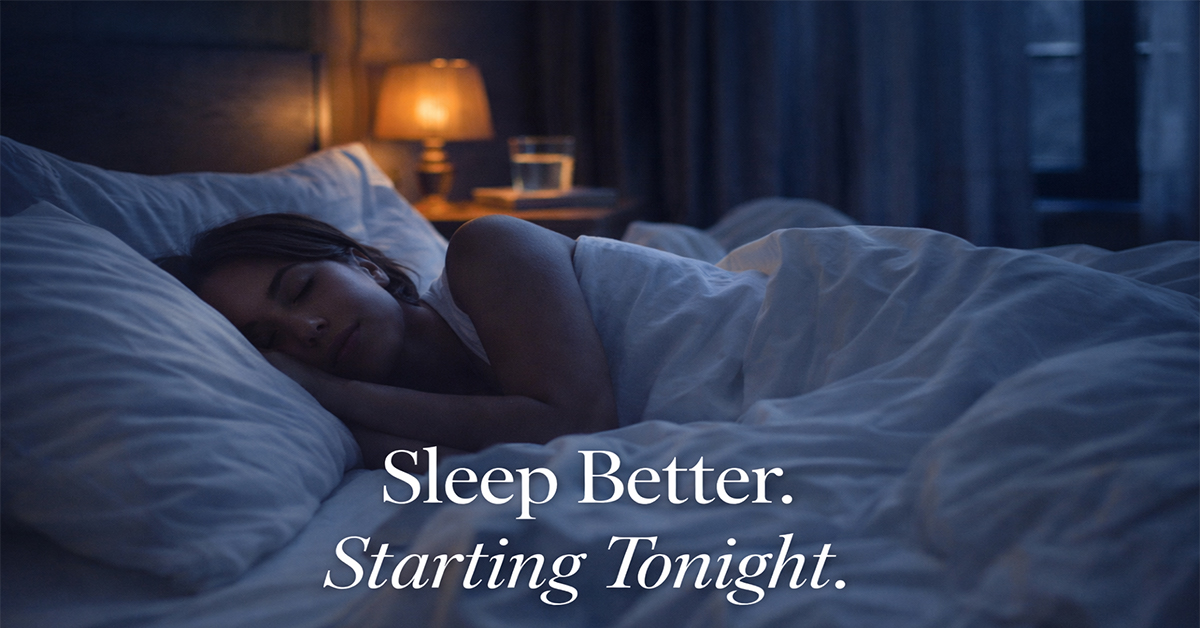
Lying awake at 2 a.m. staring at the ceiling isn’t just annoying — it’s your body trying to tell you something. Here’s what sleep science says actually works in 2026.
I’ll be honest with you: for about three years of my life, I was genuinely terrible at sleeping. Not “takes me a few extra minutes to drift off” bad. I mean lying awake for an hour or more every night, watching my phone clock tick from 11:30 to 12:15 to 1:07, brain refusing to shut up, then dragging myself out of bed feeling like I’d fought something all night rather than rested.
I tried everything I’d read about. Melatonin gummies. White noise apps. Chamomile tea. That weighted blanket everyone swore would change my life.
Some things helped a little. Most things didn’t stick. What eventually made a real difference wasn’t one magic fix — it was actually understanding why I couldn’t sleep, and then making a handful of specific changes that addressed those actual reasons.
That’s what this article is about. Not generic tips you’ve already ignored. The real mechanisms, what the science says, and what genuinely works if you give it a proper shot.
First — Why Sleep Actually Matters More Than You Think You Know
Most of us understand sleep as the absence of being awake. You lie down, you go unconscious, you wake up. Simple enough.
But what’s actually happening during those hours is anything but passive. Your brain is filing memories from the day, flushing out metabolic waste through a system called the glymphatic network, and resetting the neurochemical balance that governs your mood, focus, and emotional resilience. Your body is repairing tissues, regulating hormones, and running immune maintenance that it simply cannot do while you’re upright and functioning.
When you shortchange this process — whether by not sleeping enough hours, or by sleeping enough hours but badly — that maintenance work gets interrupted. And the effects aren’t subtle. Research consistently links chronic poor sleep to higher rates of heart disease, type 2 diabetes, obesity, anxiety, and depression. Your cortisol and adrenaline levels stay elevated longer. You become more reactive to small stressors. Your decision-making gets worse in ways you often can’t perceive clearly because — and this is the cruel part — sleep deprivation also impairs your ability to recognize how impaired you are.
In 2026, sleep medicine researchers are increasingly treating inadequate sleep not just as a symptom of stress or bad habits, but as an independent risk factor for long-term health decline — something to take as seriously as diet and exercise. That shift in framing matters, because it means improving your sleep isn’t a luxury. It’s maintenance.
The Thing That Controls More Than Anything Else: Your Body Clock
Before any tips or techniques, it helps to understand the system you’re working with.
Your circadian rhythm is your body’s internal 24-hour clock. It’s not a metaphor — it’s a real biological mechanism, driven by a cluster of neurons in the brain, that regulates when you feel alert and when you feel sleepy. Light is its primary input. Food, exercise, and social timing also influence it. When this clock is well-calibrated, sleep feels natural at night and wakefulness feels natural during the day. When it’s disrupted — irregular schedules, too much light at night, not enough light in the morning — the whole system drifts, and sleep becomes a struggle even when you’re genuinely exhausted.
The single highest-leverage habit you can build is a consistent wake time. Not just bedtime — wake time. Getting up at the same time every day, including weekends, anchors your circadian rhythm more powerfully than almost any supplement or technique. It feels strict until you’ve done it for two weeks and notice that you’re actually getting sleepy at a reasonable hour instead of lying awake until 1 a.m.
If you need two or three alarms to get up, depend on coffee to feel human, and regularly sleep until noon on weekends to “catch up” — your schedule is the first thing worth looking at, before anything else.
How to Actually Fall Asleep Faster
Build a proper wind-down routine — and treat it like a real commitment
Sleep isn’t a switch. You can’t go from scrolling work emails to deeply asleep in four minutes, regardless of how tired you feel. Your nervous system needs a landing approach — a predictable sequence of lower-stimulation activities that signal to your brain that the day is genuinely over.
This doesn’t have to be elaborate. Thirty to sixty minutes of anything calm and consistent: reading a physical book, gentle stretching, a warm shower, quiet music, dimming the lights in your home. The specific activities matter less than the fact that you do roughly the same things in roughly the same order most nights. After a few weeks, your body starts to associate that sequence with sleep onset, and you’ll often notice yourself feeling genuinely drowsy by the end of it without having done anything heroic.
The key word is consistency. A wind-down routine you do twice a week is a nice idea. One you do six nights out of seven is actually training your nervous system.
Put the phone in another room. I mean it.
I know you’ve heard this. I know you’ve probably dismissed it as oversimplified. But the evidence on this one is genuinely strong and the mechanism is clear.
The blue-spectrum light from phone and tablet screens suppresses melatonin production — your body’s signal that it’s dark and time to sleep. This isn’t folklore. It’s measurable in blood tests. Using a bright screen for an hour before bed can delay your melatonin release by up to 90 minutes in some studies, which effectively shifts your biological bedtime later even when you’re trying to sleep earlier.
But the light is honestly only half the problem. The content is the other half. News, social media, work messages, YouTube comments — all of this keeps your brain in an evaluative, reactive, stimulated state that is biochemically the opposite of where you need to be to fall asleep. Night mode settings and blue-light glasses can partially address the light issue, but they don’t address the content problem at all.
The simplest solution is the most effective one: phone charger in the kitchen, old-fashioned alarm clock on the nightstand. If this sounds extreme, notice how resistant you feel to trying it, and ask yourself what that resistance is really about.
Use your breathing deliberately
This one surprised me when I first tried it because it worked faster than I expected.
The 4-7-8 technique is simple: inhale through your nose for 4 seconds, hold for 7 seconds, exhale slowly through your mouth for 8 seconds. Repeat four to six cycles. The extended exhale activates your parasympathetic nervous system — essentially the biological “rest and digest” mode that counters the flight-or-fight state that keeps so many people wired at bedtime.
Progressive muscle relaxation is another option worth trying: working from your feet upward, you tense each muscle group for five seconds, then release. The contrast between tension and release draws attention to physical sensation and away from the mental chatter that tends to cycle at bedtime. It sounds almost too simple to work. It works.
Why You Keep Waking Up at 3 A.M.
If falling asleep isn’t the main issue but staying asleep is — that 3 a.m. awakening that happens like clockwork — the causes are usually more environmental or physiological.
Caffeine is staying in your body longer than you think. The half-life of caffeine is around 5–6 hours in most adults, and some people metabolize it significantly slower than that. A coffee at 3 p.m. still has a meaningful amount of caffeine active in your system at 9 p.m. If you’re waking in the night, shifting your last caffeine to before noon for two weeks is one of the most revealing experiments you can run on your own sleep.
Your bedroom temperature is probably too warm. Your core body temperature naturally drops in the hours after sleep onset — it’s part of the biological sleep mechanism. A room that’s too warm works against this process and creates the kind of shallow, fragmented sleep that leads to frequent waking. Research consistently points to somewhere between 16–19°C (60–67°F) as the optimal range for most people. That’s cooler than most people keep their bedrooms. Try it for a week.
- → GST Housing Rebate 2026: Why Builders Say It Won’t Fully Revive Canada’s Condo Market
- → Canada Minimum Wage Increase 2026: Federal Rate Rises to $18.15 per Hour
- → Canada Relationship Finance Survey 2026: How Economic Pressures Are Shaping Modern Relationships
- → CRA Grocery Benefit and GST/HST Credit Boost in 2026: Eligibility, Payments, and What Families Should Know
- → CRA Filing System Changes in 2026: End of Tax Drop Boxes Across Canada
- → Working While on CPP in 2026: How Your Job Can Increase or Reduce Your Pension
- → CRA $2,200 Senior Bonus (March 2026): Eligibility, Payment Date & Latest Updates
Your room might not be as dark as you think. Streetlights through thin curtains, standby lights on electronics, a phone screen lighting up with notifications — any of these can trigger brief wakefulness that you don’t even fully register but that fragments your sleep quality over the course of a night. Blackout curtains or a sleep mask are inexpensive and often surprisingly effective.
Stress is using your sleeping hours to process. If your brain doesn’t have dedicated time to worry during the day, it will create that time at night. A simple practice that genuinely helps: 15–20 minutes earlier in the evening — not right before bed — where you write down every worry, unresolved task, and thing you’re anxious about, along with one concrete first step for each. It sounds almost bureaucratic, but the act of externalizing these things onto paper genuinely reduces the brain’s compulsion to rehearse them at 3 a.m.
The Daytime Habits That Pay Off After Dark
Sleep is largely built during the day, not just managed at night.
Morning light is genuinely powerful. Getting outside within an hour of waking up — even on a cloudy day, even for 15–20 minutes — sends a strong calibration signal to your circadian clock. It helps set your body’s expectation for when daytime ends and nighttime begins, which makes falling asleep at the right time much easier. This might be the most underrated free intervention in sleep science right now.
Exercise consistently. People who move regularly fall asleep faster and spend more time in deep, restorative sleep stages. You don’t need intense workouts — regular walking, cycling, swimming, or resistance training all show benefits. The one caveat: vigorous exercise within two hours of bedtime can raise core temperature and cortisol in ways that delay sleep for some people. Earlier in the day is better.
Be honest about naps. A 20-minute nap in the early afternoon can improve alertness and mood without meaningfully disrupting nighttime sleep. A 90-minute nap at 5 p.m. borrows against tonight’s sleep drive and often leads to lying awake until midnight wondering why you’re not tired.
When It’s More Than Just Bad Habits
If you’ve tried most of what’s here and sleep is still genuinely broken most nights for three months or more, it’s worth talking to a doctor. Not because there’s necessarily something seriously wrong, but because conditions like insomnia disorder, sleep apnea, restless leg syndrome, and anxiety disorders all disrupt sleep in ways that lifestyle changes alone won’t fix.
Sleep apnea in particular is significantly underdiagnosed, including in people who don’t fit the stereotypical profile. If you’re waking frequently, snoring, waking with headaches, or feeling completely unrefreshed even after a full night’s sleep, it’s worth asking about a sleep study.
The most evidence-backed treatment for chronic insomnia, by the way, isn’t medication — it’s Cognitive Behavioral Therapy for Insomnia (CBT-I), a structured program that addresses the thought patterns and behaviors that maintain insomnia. In 2026, it’s available through digital platforms and apps as well as in-person, and the results are consistently strong and long-lasting in a way that sleep medications often aren’t.
The Bottom Line
Better sleep doesn’t usually come from one big intervention. It comes from a handful of small, consistent changes that work together — a stable wake time, a genuine wind-down routine, a cooler and darker bedroom, caffeine that stops earlier in the day, and some kind of daily stress outlet that stops your brain from saving its problem-solving for 2 a.m.
None of it is complicated. Most of it just requires actually doing it, which is harder than it sounds when you’re tired and your phone is right there and the couch is comfortable.
But the compound effect of getting this right — better mood, sharper thinking, more emotional resilience, lower long-term health risk — is one of the best returns on investment available to basically every human being alive right now.
It’s worth the effort. Starting tonight.