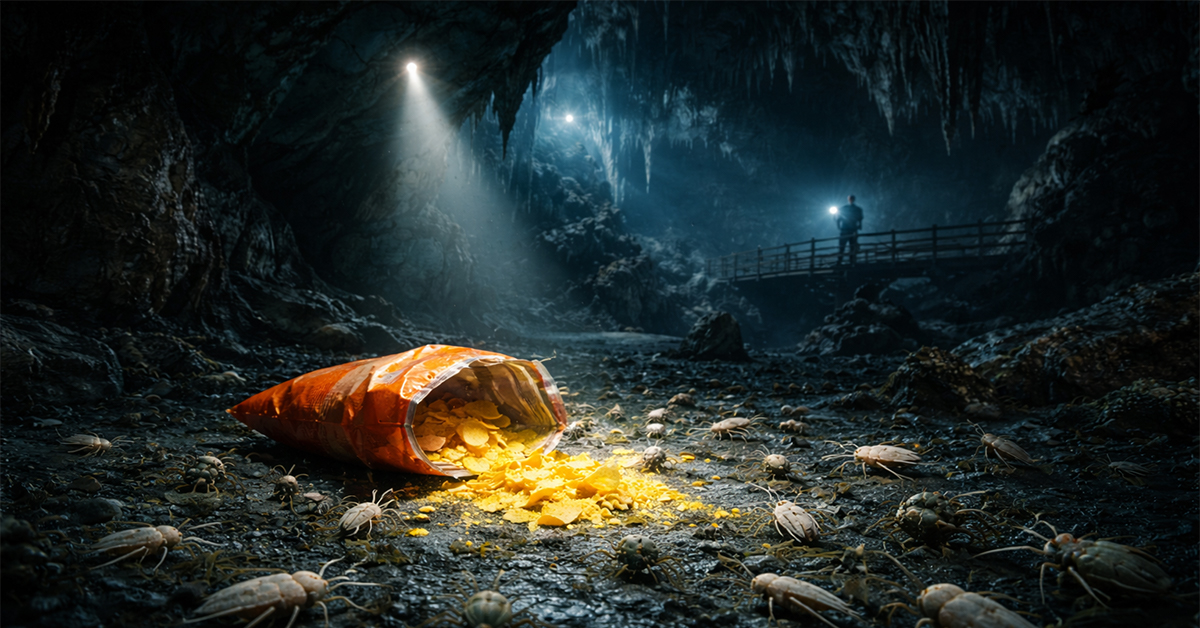
What happened inside Mammoth Cave National Park after one distracted family dropped a snack changed how rangers think about tourists — and how cave ecosystems survive.
I’ve been in enough national parks to know the unwritten rule: if you drop something near a trail edge, your instinct is to look down, sigh quietly, and keep moving. The tour group is already ten feet ahead. A kid is complaining. Your phone needs a new angle for the next shot. Nobody is going to shimmy into a dark rock crack for a half-empty snack bag.
That’s exactly what happened at Mammoth Cave National Park in Kentucky — the longest known cave system on the planet, with over 426 mapped miles of passages as of 2026. A family was deep on a guided tour when a bag of cheese chips slipped from a backpack and disappeared down a narrow crevice off the walkway. Nobody thought much of it.
What followed turned a tourist slip-up into a textbook case study in cave ecology — and quietly changed how rangers at Mammoth explain the rules to the roughly 600,000 people who visit every year.
The Cave That Hears Everything
Mammoth Cave is hard to describe if you haven’t stood inside it. You expect rock and darkness and maybe the smell of damp earth. What you don’t expect is the sound — or the lack of it. The drip of water. The low echo of footsteps on the boardwalk. The way your own breathing sounds too loud.
- → GST Housing Rebate 2026: Why Builders Say It Won’t Fully Revive Canada’s Condo Market
- → Canada Minimum Wage Increase 2026: Federal Rate Rises to $18.15 per Hour
- → Canada Relationship Finance Survey 2026: How Economic Pressures Are Shaping Modern Relationships
- → CRA Grocery Benefit and GST/HST Credit Boost in 2026: Eligibility, Payments, and What Families Should Know
- → CRA Filing System Changes in 2026: End of Tax Drop Boxes Across Canada
- → Working While on CPP in 2026: How Your Job Can Increase or Reduce Your Pension
- → CRA $2,200 Senior Bonus (March 2026): Eligibility, Payment Date & Latest Updates
The rangers who work here year-round develop an ear for anything out of place. One of them, a longtime interpretive guide, told the story later of how he first noticed something was wrong near one of the lower tour sections. Cave crickets — those pale, spindly-legged things that look like they were designed for nightmares — were clustered around a wall crack in unusual numbers, moving with a kind of urgency he hadn’t seen before.
A thin orange streak on the limestone. He thought it was oxidized iron at first. It wasn’t. It was cheese powder.
What Scientists Found in the Lower Chamber
The chip bag hadn’t just fallen and sat there. Moisture, airflow, and gravity had carried it deeper — into a lower pocket of the cave that tourism boardwalks don’t reach. Getting there required helmets, ropes, and a few hours of careful crawling through passages barely wide enough for a human torso.
When the team finally got their headlamps on it, they were looking at something that felt genuinely surreal: the shredded silver-and-orange remains of the bag plastered flat against the rock by moisture. Around it, a dense swarm of cave beetles, isopods, and crickets were feeding on the crumbs with the kind of frantic energy you don’t see in cave ecosystems. One ranger later described it as finding “a fast-food restaurant on the moon.”
That description stuck, and it’s actually scientifically accurate in a way. Cave animals evolve over millennia around extreme scarcity. There’s no sun, no photosynthesis, no food chain built on plants. Everything that lives down there depends on tiny trickles of organic matter — bat guano, washed-in leaf fragments, the occasional dead insect blown in by airflow. The entire food web is tuned to run on almost nothing.
Drop a processed, calorie-dense, salt-heavy snack into that ecosystem, and you’re not just feeding a few bugs. You’re temporarily rewriting the rules of who thrives, who moves, who breeds, and who gets crowded out.
The Data That Made It Real
What made the Mammoth Cave chip incident particularly useful for scientists was timing. The crevice where the bag landed happened to fall within an existing long-term biodiversity monitoring zone. That meant there was years of baseline data already collected — invertebrate counts, species distribution, bacterial load on rock surfaces, behavior patterns. Researchers knew exactly what “normal” looked like in that chamber.
After the bag was discovered, the team set up motion-activated cameras and environmental sensors around the contamination point. What they tracked over the following weeks was measurable and clear:
- Invertebrate density in the immediate zone spiked significantly compared to baseline data from the same period in prior years.
- Cave crickets kept returning to the site even after most of the food was gone — appearing to retain a spatial “memory” of the calorie source.
- Certain beetle species became hyperactive in the zone, while others — species that normally share that habitat — dropped in visible numbers nearby.
- Microbial swabs of cheese-powder-touched rocks showed elevated bacterial activity well after the crumbs were physically gone.
- There was a measurable pull effect — invertebrate concentration clustered toward the food site, leaving a subtle depletion pattern a few meters away.
Individually, none of these things sounds catastrophic. Put them together across thousands of daily visitors each dropping something tiny, and the math changes fast.
It’s Not Just Mammoth Cave
Other show caves and underground parks across the US have documented similar disruptions. At Carlsbad Caverns in New Mexico — another World Heritage Site and one of the most biodiverse cave systems in North America — rangers have tracked shifts in where certain animals gather near bat-flight viewing areas. The culprit in those cases? Visitors leaving crumbs or food packaging near the amphitheater seating during the famous evening bat emergence.
Above ground, raccoons at several national parks have shifted their foraging routes toward parking lots and cave entrances because of the lingering food smell from visitors. Behavior changes like that seem minor until you realize a predator that’s stopped hunting naturally is a predator that’s now depending on human patterns to eat — which creates its own cascading problems.
Inside Mammoth itself, a ranger once described finding a sandwich wedged under a rock in a show cave section. The localized fungal and bacterial bloom from that single food item produced a smell that lasted weeks and required intervention. A sandwich. One sandwich.
Why Our Brains Are Bad at This
Here’s the honest thing: nobody drops a chip bag on purpose. That’s not how any of this works, and it’s not the point. The problem isn’t malice — it’s the gap between how we perceive “small” and how ecosystems experience it.
We’re built to assess scale visually. A spilled handful of crumbs looks like nothing. A cave that stretches for hundreds of miles looks indestructible. That mismatch in scale perception makes the damage invisible right up until it shows up in a monitoring dataset years later.
One of Mammoth Cave’s interpretive rangers put it in a way that I think is genuinely the best framing I’ve heard on this: “People think wilderness is huge and strong. Down here, it’s small and fragile and counting on you to be boringly careful.”
Boringly careful. That phrase does a lot of work. It removes the heroism from conservation and makes it something ordinary — a zip on a backpack, a second look before leaving a bench, a slightly less convenient snacking habit.
What Actually Works: A Practical Guide for 2026 Cave Visitors
I’m not going to tell you to stop snacking on hikes. That’s not realistic advice for anyone traveling with kids, long tours, or low blood sugar. But there are a few habits that make a genuine difference, backed by what rangers and scientists have actually found works:
1. The Double-Bag System
Bring one bag for your food, one bag — bright-colored, so you can see it in the dark — specifically for trash. Zip both. The extra step of seeing a separate trash bag makes it psychologically harder to “forget” it. Rangers at Mammoth started recommending this in 2024 after tracking a measurable drop in incidental food waste on tours where the guide mentioned it in the pre-tour briefing.
2. Choose Non-Crumbling Snacks
Whole fruit, nuts in sealed containers, wrapped sandwiches. Anything that doesn’t shed powder or fragments when you open it. Chip bags and crackers are the worst offenders underground because the smallest particle travels further in cave airflow than you’d expect.
3. Eat Only in Designated Rest Areas
Not while walking, not while photographing something interesting. Most national park cave tours have specific stopping points with proper flooring. Use them. The reason isn’t arbitrary — it’s that moving while eating dramatically increases the scatter radius of crumbs.
4. The 10-Second Exit Check
Before walking back to your car after any nature visit: 10 seconds. Check pockets. Check the bench you were sitting on. Check the ground around your feet. This habit alone catches the majority of accidental drops before they become ecological incidents.
5. Tell Kids One Story Before the Tour
Not a rule. A story. “There are blind cave beetles in there that have never seen light, and they’re counting on it being quiet and clean.” Kids who have a character — even an invertebrate one — to protect behave differently on the tour. Rangers started using this approach formally in 2025 with school groups and saw measurable drops in intentional rule-bending.
What a Chip Bag Teaches Us About Environmental Thinking
The cheese chips are gone now. The chamber was cleaned, the data was collected and folded into ongoing biodiversity research at Mammoth Cave. The bag ended up cited in at least one peer-reviewed paper on anthropogenic food contamination in managed cave environments.
We tend to imagine environmental harm at a scale that feels proportional to its consequences — oil spills, deforestation, industrial runoff. The everyday reality of how most ecosystems actually get stressed is quieter and smaller. It looks like a chip bag in a crevice. A straw in a creek. A granola bar wrapper wedged into sandstone.
What I keep thinking about is the strange reversal in this story. A cave — ancient, dark, 400 miles of it under Kentucky — ended up quietly changing how thousands of people now carry their snacks. A hidden world adjusted the behavior of the surface world, one tour group at a time.